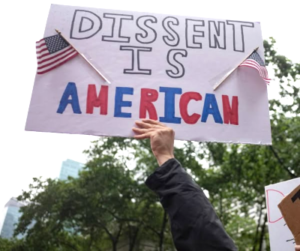
The Situation:
On Saturday, January 24, 2026, ICE officers shot and killed Alex Pretti in Minneapolis, Minnesota (Barry, 2026), their second fatal shooting in the city in 2026 (Staton, 2026). The homicide was recorded by citizen journalists on video (Leswing, 2026), and has sparked protests in the city (Barry, 2026).
The Trump administration has been careful to inform the public about the shooting, with President Trump himself weighing in on the incident (Landers, 2026).
Border Patrol Commander Greg Bovino reported that “This looks like a situation where an individual wanted to do maximum damage and massacre law enforcement” (Barnett, 2026) and stressed that the officers, victims of an attack, were justified in their response (Palmer, 2026).
CommanderBovino: “I believe that the fantastic training that our law enforcement partners have, the fact that they’re highly trained, prevented any specific shootings of law enforcement. So good job for our law enforcement in taking him down before he was able to do that” (Palmer, 2026).
Homeland Security Secretary Kristi Noem defended the shooting, saying that Pretti, brandishing a firearm, attacked the officers, further indicating that the officers were justified in their response (Dale, 2026).
Secretary Noem: “[He] wasn’t there to peacefully protest, he was there to perpetuate violence… Domestic terrorism” (Epstein, 2026).
White House deputy chief of staff Stephen Miller also defended the shooting, pointing out that Pretti was an “assassin” trying to “murder federal agents” (Dale, 2026). This position was repeated in a published statement by Vice President JD Vance (Dale, 2026).
FBI Director Kash Patel pointed out that Pretti was breaking the law by carrying a concealed firearm to a protest (Dale, 2026).
President Trump has not contradicted any of the official statements made by federal officials in the aftermath of the shooting, and himself offered the statement that “You can’t have guns. You can’t walk in with guns,” indicating that Pretti was in the wrong (Landers, 2026). Trump told Fox News of the immigration enforcement efforts, “we took thousands of hardened criminals” out of Minnesota, “so they have good crime numbers” (Epstein. 2026) before offering that his administration is “going to de-escalate a little bit” in Minnesota (Epstein. 2026).
The Disagreement:
I disagree with Commander Bovino. There is no indication of hostility on the part of the victim, and no indication of good training on the part of the officers.
I disagree with Secretary Noem. There’s no sign the victim ever touched his firearm, and no sign of hostility on the part of the victim.
I disagree with deputy chief Miller–and with Vice President Vance–when they claim the victim was an assassin. There is absolutely no evidence of ill intent on the part of the victim, and copious evidence of the officers’ hostility in the videos.
I disagree with FBI Director Patel when he claims the victim was breaking the law by carrying a concealed firearm to a protest; in fact, local authorities confirmed that the victim’s weapon was legally registered (Epstein, 2026).
By the same token, I disagree with President Trump when he asserts that the victim should not have had a firearm. In my opinion, he was simply exercising both his first and second amendment rights, neither of which carries any penalty–much less a death penalty.
I disagree with President Trump that a measure of success is removing “thousands” of hardened criminals. In my opinion, this, even if it were true, is not a measure of success; the operation is an undeniable failure,as it terrorizes Minnesotans and fails to address the root causes of violence, the federal agents themselves.
I Disagree with President Trump’s tacit approval of the statements made by those in his administration, under his command. Since the statements are overwhelmingly false and slanderous, I believe that President Trump should refute them strongly and publicly. ICE has not done a “good job.”
I disagree with President Trump that a solution is to “de-escalate a little bit.” In my opinion, that does not go nearly far enough, as I have pointed out in my article on the homicide of Renee Nicole Good. All ICE operations should be suspended until such time as a plan is in place to enforce the law with safety and respect.
Desired Resolution:
I would like to see President Trump use the power and authority of his office to halt all immigration enforcement actions by the federal government until they can be carried out safely–and respectfully. I would like to see President Trump ensure a full, fair, and complete investigation into the death of Mr. Pretti a the hands of ICE, and to hold those responsible for his death accountable. I would like to see President Trump take concrete steps to ensure that such tragedies do not occur again.
I encourage President Trump to work to make the United States of America a beacon of freedom for the world, to teach the nations through strong, compassionate leadership how freedom should look.
May God bless President Trump and the United States of America.
References:
Barry, Dan. “A Shocked Nation Watches Minneapolis Killings: ‘Something Needs to Change'” 1/27/2026. https://www.nytimes.com/2026/01/27/us/alex-pretti-shooting-minneapolis-reaction.html – Accessed 1/28/2026.
Staton, Benjamin. “The 2026 Homicide of Renee Nicole Good.” 1/8/2026. https://sgtstaton.com/2026/01/08/the-2026-homicide-of-renee-nicole-good/ – Accessed 1/28/2026.
Leswing, Kif and Terri Cullen. “Videos of Alex Pretti shooting by federal agents in Minneapolis contradict Trump official claims.” 1/25/2026. https://www.cnbc.com/2026/01/25/alex-pretti-minneapolis-shooting-videos-trump.html – Accessed 1/28/2026.
Epstein, Kayla. “Trump says government will ‘de-escalate’ in Minnesota following Pretti shooting.” 1/28/2026. https://www.bbc.com/news/articles/c0q425vg4qzo – Accessed 1/28/2026.
Landers, Liz and Joshua Barajas. “WATCH: ‘You can’t have guns. You can’t walk in with guns,’ Trump says of Alex Pretti
killing.” 1/27/2026. https://www.pbs.org/newshour/politics/watch-you-cant-have-guns-you-cant-walk-in-with-guns-trump-says-of-alex-pretti-killing – Accessed 1/28/2026.
Dale, Daniel. “What Trump officials claimed about Alex Pretti — and what the evidence actually shows.” 12/29/2026. https://www.cnn.com/2026/01/25/politics/trump-officials-shifting-rhetoric-alex-pretti – Accessed 1/28/2026.
Barnett, Sofia. “Fact check: Video, witnesses contradict critical claims of federal officials in Pretti shooting” 1/25/2026. https://www.startribune.com/fact-check-federal-officials-claims-about-fatal-minneapolis-shooting/601570444 – Accessed 1/28/2026.
Palmer, Kathryn. “Border Patrol chief calls agents the ‘victims’ in Pretti shooting.” 1/26/2026. https://www.usatoday.com/story/news/nation/2026/01/26/greg-bovino-agents-victims-pretti-minneapolis-shooting/88361659007/ – Accessed 1/28/2026.
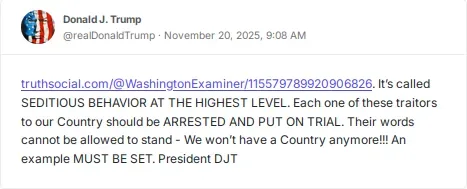 (Trump, 2025)
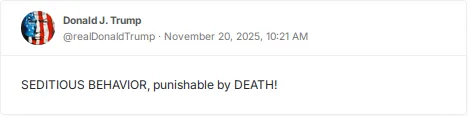 (Trump, 2025)
 (Trump, 2025)